

On May 1, 2026, I experienced an encounter that will likely remain with me for a long time in both my academic journey and personal growth – a profound conversation with the painter He Shuaizhen, who defines himself as an “ecological and peace-oriented artist.”
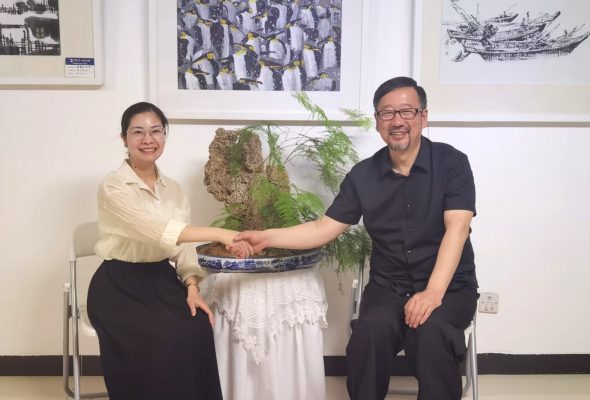
What made this meeting particularly meaningful is that it began almost by chance.
About a week earlier, I happened to reopen a discussion group on ecology and sustainable development – one that I had joined a year ago after attending an environmental event. While browsing through the messages, I came across a post about He Shuaizhen’s ecological art exhibition, “Blueprint Dreams · Wonderful Realm Xiong’an,” held in Xiong’an New Area – notably the first place visited by Vietnam’s General Secretary and President Tô Lâm during his state visit to China in mid-April this year.
This coincidence made me pause.
Yet what truly drew my attention was not only Xiong’an as a symbol of China’s future-oriented urban vision, but the artist behind the exhibition. He is not merely a painter, but a thinker who connects life, ecology, art, and the inner world.
I reached out to him – and to my surprise, within a short time, I was invited to visit his personal studio.
The conversation lasted nearly two hours, yet it felt more like a journey of perception and awakening.
From Personal Crisis to Ecological Mission
What left the deepest impression on me was his life story.
In 2008, he went through a profound psychological crisis, at one point even contemplating ending his life. It was during this period that he began engaging with the teachings of Eastern sages such as Confucius, Laozi, and Shakyamuni Buddha.
He described this experience as a form of “awakening” – a deep realization of the essence of life and humanity’s place in the universe.
From that moment, he not only emerged from his inner struggles but also discovered a sense of mission.
Gradually, he shifted from being a painter of diverse subjects to focusing primarily on ecological art and themes of peace. In his view, the color blue is not only the color of nature and the cosmos, but also a symbol of tranquility, balance, and healing.
Chinese traditional wisdom, ink painting, and deep reflections on the relationship between humans and nature have together shaped his artistic path and intellectual direction.
Art as a Reflection of the Inner World
If philosophy shapes one’s worldview, then art is the expression of that worldview.
He emphasized that art should not be confined to material value or the artwork itself. Its essence lies in the “Dao” – the depth of thought and inner cultivation of the artist.
Whether painting, calligraphy, or music, artistic works are fundamentally reflections of the inner self:
Those with depth of thought create works with depth.
Those lacking “Dao” struggle to move others.
He also highlighted one of art’s most unique qualities: its universality beyond language. Unlike words, art requires no translation. A painting or a melody can directly touch human emotions.
However, for art to achieve this, it must be “for humanity”, it must respond to human emotional and spiritual needs. Even the most technically refined work loses meaning if it fails to resonate.
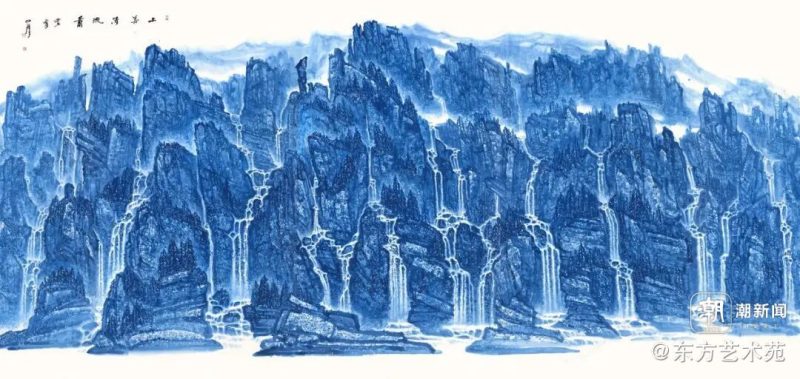 https://tidenews.com.cn/tmh_news.html?id=69acdfe72cc8fb0001f6efd8
“Dao” and the World as an Integrated Whole
Throughout our conversation, he repeatedly emphasized a core idea:
At their deepest level, different traditions – whether Buddhism, Daoism, Confucianism, Christianity, or Islam – share common principles.
From this perspective, the world is not a collection of isolated individuals, but an organic whole. Humans and humans, humans and nature, all are fundamentally interdependent, coexisting and co-flourishing.
“When this exists, that exists; when this ceases, that ceases.
When this arises, that arises; when this perishes, that perishes.”
This is not merely a moral intuition, but a logic of existence and a philosophical foundation for the idea of a “shared future for humankind.”
“Economy” as Philosophy: From Classical Wisdom to Shared Development
One of the most thought-provoking parts of our exchange was his reinterpretation of the concepts of “business” and “economy.”
In his view:
The “sheng” (生) in business represents life, living, and ecology.
The “yi” (意) represents meaning, thought, and purpose.
Thus, business is not merely about profit, but about creating value and achieving mutual benefit. Without “win-win” outcomes, it cannot be sustainable. To truly understand business is to understand the meaning of life itself.
Similarly, “economy” (经济) can be understood as:
“Jing” (经): classical wisdom, accumulated knowledge
“Ji” (济): to assist, to support, to help others
In this sense, economic activity is not just production and exchange, but the application of human wisdom to create value and contribute to society. It is also a social process through which relationships and trust are built.
He connected this philosophy to contemporary international cooperation, such as the Belt and Road Initiative, emphasizing the principle of “co-building and shared benefits.” Development, in this view, is not a zero-sum game, but a process of mutual reinforcement.
He also referred to the traditional principle of “giving more and taking less” , the more one gives without expecting return, the more one ultimately receives. This is both a cultural ethos and a logic of sustainable cooperation.
As a researcher in international development, I found this perspective highly relevant. If economic actors and policymakers truly internalize this principle, global cooperation may evolve, from competition to coordination, from rivalry to co-existence.
Reflection: Dialogue as the Precondition for Peace
After the meeting, what remained with me was not only a set of ideas, but a clearer realization:
Peace — whether at the national or global level — cannot exist without mutual understanding.
And understanding begins with dialogue.
Dialogue between civilizations
Dialogue between cultures
Dialogue between humans and nature
Dialogue between art and society
And most importantly, dialogue between people
I began to realize that all complex problems ultimately point back to fundamental questions:
To what extent do we truly understand one another?
Are we willing to collaborate in creating a better life together?
Are we willing to live in harmony with nature?
More deeply, these questions are also connected to the “Five Blessings” in Eastern philosophy as longevity, prosperity, health, virtue, and a fulfilling end, and to the broader vision of building a shared future for humanity.
A Beginning
Whether this encounter was a coincidence or a kind of inevitability may not matter.
What matters more is that it may mark a beginning.
A beginning in which ecology, art, inner life, philosophy, research, and practice are no longer separate domains, but begin to engage, understand, to recognize, to cooperate and to co-flourish.
Perhaps it is through such encounters that visible and invisible bridges will gradually be built.
Time will tell.
- Master’s Thesis at Ritsumeikan University, Kyoto, Japan, 2013-2015
- From Energy to the Middle Corridor: Prospects for Strategic Cooperation between Vietnam and Azerbaijan
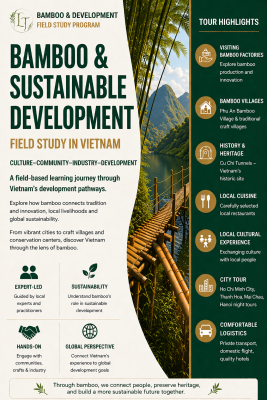
- Vietnam Bamboo and Sustainable Development Field Study Program
- People-to-People Exchanges: Linh Tran’s Perspective on ASEAN–China Cooperation
- BAMBOO and I
Bài viết cùng chủ đề:

Why I Became a Teacher?

BAMBOO and I

From Energy to the Middle Corridor: Prospects for Strategic Cooperation between Vietnam and Azerbaijan

Asking the Way of Youth: China–ASEAN Youth and the Journey of Building Trust

Vietnam Bamboo and Sustainable Development Field Study Program

Dialogue on the Future of ASEAN–China Relations: The Role of Youth in Building Trust and Cooperation

People-to-People Exchanges: Linh Tran’s Perspective on ASEAN–China Cooperation

May 2026 Reflection: When the Streams Converge