

From Learner to Lecturer: My Journey into Teaching
Looking back, I realize that my journey into teaching did not begin when I first stood in front of a university classroom. It began much earlier, long before I ever imagined becoming a lecturer.
As a secondary and high school student, I often helped younger family members with their studies. At the time, I never considered it teaching. I was simply sharing what I knew. Yet in retrospect, those moments planted the first seeds of something that would later become an important part of my life: the joy of helping others learn.
During my high school years, teaching gradually became more than just helping family members. I volunteered to teach English and cultural subjects to children at SOS Children’s Villages and participated in educational activities for young learners. Although I was still a student myself, I discovered that I genuinely enjoyed explaining ideas, encouraging curiosity, and helping others gain confidence through learning.
These experiences taught me an important lesson at an early age: knowledge becomes more meaningful when it is shared.
When I later moved to Hanoi for university, teaching continued to appear naturally in different forms. I joined volunteer English teaching programs and educational activities for young people. Even then, I did not yet have a clear plan to become a professional educator. However, I noticed a pattern: wherever I went, I seemed to find myself returning to teaching.
Language became another bridge connecting me to education. Living and studying in different countries gave me opportunities to teach Vietnamese to foreigners and to share aspects of Vietnamese culture with people from diverse backgrounds. Whether in France, Japan, China, or later in Vietnam, I discovered that teaching was not only about language. It was also about communication, cultural understanding, and human connection.
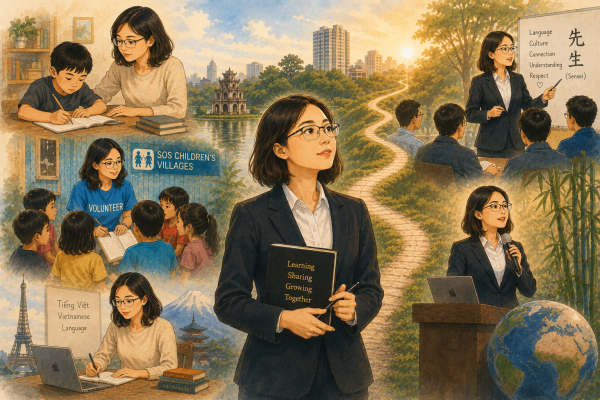
One experience in Japan had a particularly profound impact on me. While pursuing my Master’s degree in Kyoto, I worked part-time to support my living expenses. One of my jobs was in a lunch box factory performing manual labor. The other was teaching foreign languages to Japanese learners, including Vietnamese, English, and French. The contrast between these two jobs was striking.
In the factory, I worked hard and honestly, but I was simply one worker among many. The work was physically demanding, and there was little room for personal interaction or intellectual exchange.
Teaching was entirely different. Not only was the income significantly higher, but more importantly, it carried a different kind of meaning. Many of my students were older than me. Some were businesspeople, some were professionals, and some were even senior public officials. Yet despite the age and experience differences, they treated me with genuine respect and always addressed me as “Linh Sensei.”
For the first time, I experienced what it meant to be respected not for one’s position, wealth, or social status, but for one’s knowledge and ability to help others grow.
It was during that period that I made an important decision. One day, I told myself: “I definitely will become a teacher in the future.”
Not simply because teaching was a respectable profession, although it certainly is. Not simply because I enjoyed sharing knowledge, although I always have.
I wanted to become a teacher because I realized that teaching united many things that mattered deeply to me. I have always loved learning. I have always believed that teaching is one of the most effective ways of learning. I have always been curious about people, cultures, and ideas. And I have always wanted my knowledge and experiences to create value beyond myself. Teaching brought all of these elements together.
Over the years, this aspiration eventually led me into higher education, where I had the opportunity to teach university students in Vietnam. Yet even after becoming a lecturer, I never viewed teaching merely as a profession. Instead, I came to see it as a lifelong practice of learning, sharing, and growing together with others.
Today, my work has expanded into international development, intercultural communication, research, and global cooperation. However, the identity of a teacher remains an essential part of who I am. Whether I am conducting research, organizing international projects, promoting bamboo as a bridge between cultures, or speaking about sustainable development, I continue to see education as one of the most powerful ways to create positive change.
Looking back, I realize that becoming a teacher was never a single decision made at one moment in time. It was a journey shaped by countless small experiences: helping younger relatives with homework, volunteering with children, teaching languages across cultures, and discovering the profound meaning of being called “Sensei.”
Those experiences did not simply lead me to teaching. They helped me understand who I wanted to become.
- Dialogue on the Future of ASEAN–China Relations: The Role of Youth in Building Trust and Cooperation
- People-to-People Exchanges: Linh Tran’s Perspective on ASEAN–China Cooperation
- An Encounter Beyond Expectations: When Life, Ecology, Art, and Philosophy Converge
- BAMBOO and I
- From Energy to the Middle Corridor: Prospects for Strategic Cooperation between Vietnam and Azerbaijan
Bài viết cùng chủ đề:

BAMBOO and I

From Energy to the Middle Corridor: Prospects for Strategic Cooperation between Vietnam and Azerbaijan

Asking the Way of Youth: China–ASEAN Youth and the Journey of Building Trust

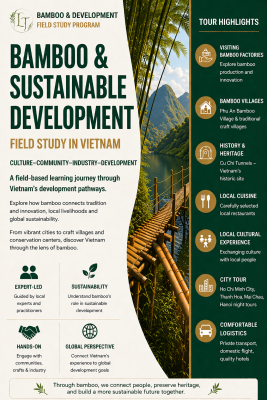
Vietnam Bamboo and Sustainable Development Field Study Program

Dialogue on the Future of ASEAN–China Relations: The Role of Youth in Building Trust and Cooperation

People-to-People Exchanges: Linh Tran’s Perspective on ASEAN–China Cooperation

May 2026 Reflection: When the Streams Converge

An Encounter Beyond Expectations: When Life, Ecology, Art, and Philosophy Converge